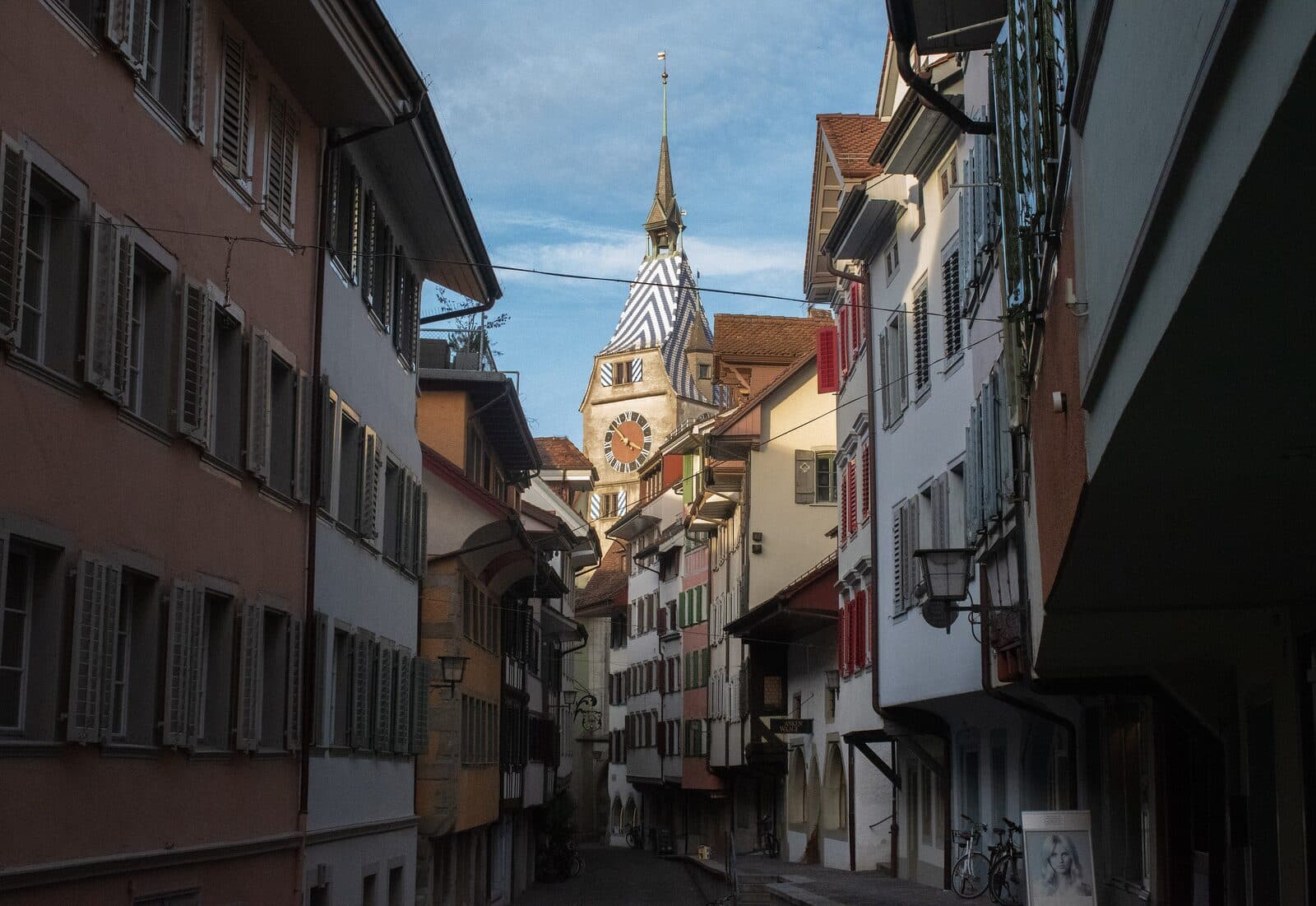
Cantonal Migration Office of Zug, Crypto-Valley, high density of expatriates, cantonal bar register.
Last reviewed
03.06.2026
Statute as of
01.01.2024
Statute citations
6 linked
Reading time
30 min read
As of: 01.06.2026 · Snapshot
Canton of Zug — Immigration Practice (cantonal focus)
1. Overview — the Canton of Zug in the context of migration law
Frequently asked
4 answers on this topic.
Concrete questions people ask about Zug.
At the Zug Migration Office, Aabachstrasse 1, 6300 Zug. Book an online appointment via zg.ch/migration. The Canton of Zug is small and efficient – processing times are often shorter than in Zurich/Geneva. The language used in proceedings is German.
The Canton of Zug is one of the smallest cantons in Switzerland in terms of area and population, but it is a special case in terms of migration law, with a disproportionately large economic impact. With approximately
128,000 inhabitants
(as of 2024, Federal Office of Statistics;
VERIFY
2026) and a proportion of around
28 per cent
of people with foreign nationality, the canton has a significantly lower relative proportion of foreign nationals than Geneva (~40%), but is at a comparable level to Zurich (~27%).
The migration landscape in Zug differs structurally from both Geneva and Zurich: while Geneva is characterised by the UN/IO sector and Zurich by its financial centre with a broad economic base, the Zug landscape is dominated by the international commodity trade, the crypto and blockchain cluster ("Crypto Valley"), and a dense network of holding companies and internationally active companies based in the canton. This economic structure generates an above-average large migration population from the highly qualified segment – namely third-country nationals from the banking, trading, tech and crypto sectors, as well as EU/EFTA nationals from the corresponding industries.
The competent cantonal authority for all residence permit procedures is the Cantonal Migration Office of the Canton of Zug (AfM ZG).
Main office, Office for Migration Zug: Aabachstrasse 1, 6301 Zug
Postal address: 6301 Zug
Telephone: +41 41 594 40 00 (central contact point)
E-Mail:
Return Department (Measures): +41 41 594 40 60 ·
Counter opening hours: Mon–Fri 08:00–11:00 and 14:00–16:00 (VERIFY 2026)
Online portal: zg.ch/behoerden/sicherheitsdirektion/amt-fuer-migration
1.1 Zug’s migrant population in figures
Rough approximation (as of 2024, VERIFY 2026): EU/EFTA nationals are the dominant group, in particular from Germany, Italy, Portugal, France, Spain, and increasingly from Eastern Europe. Third-country nationals include the United Kingdom (post-Brexit), the USA, India, China, Russia, Ukraine, as well as Turkey, Kosovo, North Macedonia, and Sri Lanka. B residence permits are the most common category, with a disproportionately high proportion in the highly skilled segment (Art. 18 ff. AIG); C settlement permits are the second most common; L short-term permits are disproportionately common in the trading and consulting sectors; G cross-border permits are present, but less dominant in terms of numbers than in GE/TI/BS. Ci permits are small in relation to Geneva (see section 5). F/N permits are distributed according to the SEM distribution key (Art. 27 AsylA). VERIFY the exact statistics for 2026 from BFS and the cantonal statistical office.
2. Legal basis — Federal law and cantonal implementing law
2.1 Applicable Federal Law
In immigration law, the Canton of Zug – like all cantons – primarily applies federal law: the Federal Act on Foreign Nationals and Integration (AIG, SR 142.20), the Ordinance on Admission, Residence and Employment (VZAE, SR 142.201), the Agreement on the Free Movement of Persons (FZA, SR 0.142.112.681) and the associated implementing ordinances, the Asylum Act (AsylG, SR 142.31), as well as the relevant SEM practice and guidelines. For the legal basis, see framework/fw_aig_vzae_glossary.md, framework/fw_fza_vfp_glossary.md and framework/fw_asylg_glossary.md.
2.2 Cantonal implementing legislation
At cantonal level, the following are particularly relevant:
Implementing Ordinance to the Federal Act on the Freedom of Movement of Lawyers (IO LLCA, SR 163.1): cantonal implementation of the LLCA, which, among other things, governs the cantonal bar register and the jurisdiction of the supervisory commission.
Ordinance on Lawyers (Lawyers’ Ordinance of the Canton of Zurich, SR 163.4): Implementing ordinance to the Cantonal LLCA.
Administrative Procedure Act of the Canton of Zug (VRG ZG): cantonal procedural law for proceedings before the cantonal administrative authorities and the Administrative Court.
Implementing Ordinance to the FNIA and Asylum Act (the cantonal designation and BGS numbering may change; VERIFY the current status for 2026 via bgs.zg.ch).
Cantonal Citizenship Act: Specifies the naturalisation procedure under the Swiss Citizenship Act at cantonal level (see section 9).
A consolidated overview of cantonal ordinances relating to migration can be found in framework/fw_cantonal_acts_index.md.
3. Structure of the Zug Migration Office
The AfM ZG is organised as an office of the Directorate for Security. Compared to the large office structures in Geneva (OCPM) and Zurich (Migrationsamt ZH, with a six-figure migrant population), it is significantly smaller in terms of its organisational structure. It handles the ordinary immigration procedures (B EU/EFTA, B third-country nationals, L, C, extensions and changes of status), family reunification under Art. 42 ff. and Fedlex·Art. 44 AIG, the naturalisation coordination (see section 9), and, via the Return Department (Measures), the asylum-specific enforcement of removal orders (+41 41 594 40 60 · ). The exact internal organisation may change and can be verified on zg.ch.
Anti-Scope (ADR-017 F8): The Returns Department is not a general point of contact for tourists who have overstayed their permitted stay or for third-country nationals who have been removed in accordance with ordinary immigration law and who do not have an asylum context. It is an enforcement agency in cases of asylum removals.
4. Zug Practice Points — what distinguishes the Canton of Zug in terms of migration law
4.1 Proof of language skills — German
In order to grant a B residence permit for family reunification from a third country, the cantonal migration office requires proof of German language skills at level A1 (oral), in accordance with the Common European Framework of Reference for Languages (CEFR), based on Art. 58a para. 1 lit. c AIG and Fedlex·Art. 77d VZAE. For the early granting of the C settlement permit after five years (Art. 34 para. 4 AIG in conjunction with Fedlex·Art. 60a VZAE), practice requires a level of B1 (oral) and A1 (written) in German.
In particular, the fide certificate in German and the diplomas and certificates mentioned in Fedlex·Art. 77d VZAE (telc, Goethe, ÖSD at the corresponding level) are accepted. In the Zug context, the Standard German variant is the decisive one; Swiss German is not relevant for the examination. VERIFY the exact requirements of the Zug practice for 2026, as cantonal interpretations may be stricter or more lenient in certain cases than the federal standard.
4.2 Integration agreement — rarely used
According to Art. 58a and Art. 58b LEI/LStrI/FNIA, the canton can conclude an integration agreement or issue an integration recommendation with third-country nationals who have integration deficits. The Zug practice uses these instruments rarely and on a case-by-case basis — unlike the canton of Vaud, which is known for its systematic use of the Convention d'intégration. An integration agreement in Zug is typically only applied when significant deficits in the areas of language, employment or respect for public safety and order are identified during an extension. The small size of the canton allows for a comparatively individualised record-keeping process. VERIFY the current practice in 2026.
4.3 Hardship case under Art. 30 para. 1 lit. b LEI/LStrI/FNIA
The Zug approach to hardship cases places it in the middle ground at the intercantonal level: it is not as accessible as the Geneva approach, nor as restrictive as the approach adopted by Aargau in 2024. The assessment is carried out on a case-by-case basis and at the discretion of the authorities, in accordance with Article 31 of the VZAE, using the standard criteria set out in federal law — integration (language, employment, social integration), family circumstances, financial situation, length of stay, state of health and prospects of reintegration in the country of origin. The requirement for SEM approval under Article 99 of the AIG must be observed and can substantially extend the overall duration of a hardship case procedure.
Anti-Scope: SwissImmigrationPro does not provide strategic advice on how to argue a hardship case. The case-specific presentation of evidence and interpretation of the indefinite legal terms are part of legal practice and must be handled by lawyers registered in the Zug cantonal bar register (see section 11).
4.4 C settlement permit issued early — moderate practice
The early granting of the C settlement permit after five instead of ten years (Art. 34 para. 4 AIG) requires successful integration and is at the discretion of the cantonal authority. According to available indicators, the Zug practice is moderate: neither particularly restrictive nor particularly generous. Key factors are enhanced language skills (B1 oral, A1 written), economic independence without receiving social assistance, no debt, no tax arrears and no entry in the criminal record. Reliable cantonal statistics on the approval rate are not published; VERIFY the current status for 2026 with the AfM ZG.
4.5 Family reunification — Zuger interpretation
In cases of family reunification from third countries (Art. 43–47 AIG), the AfM ZG examines the cumulative requirements (income, suitable accommodation, no dependence on social welfare, language, integration) according to federal standards. The market reality of the Zug housing market — one of the most expensive in Switzerland — is taken into account on a case-by-case basis. For the reunification of children, the age limit of 12 years (Art. 47 para. 1 AIG in conjunction with Fedlex·Art. 73 VZAE) or the reunification period of 5 years applies; in the case of late applications, the AfM examines "important family reasons" (Art. 47 para. 4 AIG, case-law practice according to BGE 137 I 284 ff.). VERIFY the current Zug interpretation practice for 2026.
4.6 Practice in cases of separation and divorce
In the event of separation or divorce from Swiss citizens or C permit holders, Art. 50 LEI/LStrI/FNIA applies (three years of marital cohabitation + integration according to para. 1 lit. a; important personal reasons according to para. 1 lit. b, in particular domestic violence). For victim support coordination, see section 13. Further information: life-events/le_separation_divorce.md.
4.7 Highly Qualified Individuals Segment and Issuance of B Permits to Third-Country Nationals
Due to its economic structure (holding company location, raw materials trading, crypto cluster), Zug sees a disproportionately high number of applications for B residence permits from third-country nationals in the highly qualified segment under Articles 18–25 LEI/LStrI/FNIA. The cantonal practice has established procedures for this. In particular, the priority of domestic and EU/EFTA workers (Article 21 LEI/LStrI/FNIA), personal requirements (Article 23 LEI/LStrI/FNIA), and wage and working conditions are examined; the permit is granted within the framework of the federal quotas (Articles 19, 20 LEI/LStrI/FNIA).
Anti-Scope: SIP does not provide information on how a specific third-country national B application could be "optimised" through the choice of words, job description or salary structure. These design issues are the responsibility of employers, HR departments and specialist legal counsel.
5. Implementation of the Agreement on the Free Movement of Persons in Zug — smaller scale than in Geneva
While Geneva is the largest IO location worldwide outside of New York (~40,000 holders of Carte de Légitimation plus accompanying persons), Zug hosts only a small number of IOs with headquarters agreements, and in particular no UN locations. The few IOs based in Zug have headquarters agreements with Switzerland, which apply on a case-by-case basis. VERIFY the current figures for 2026 with the EDA.
The Ci permit is issued to accompanying family members (spouses, minor children) of persons holding a Carte de légitimation from the EDA, provided that they intend to be employed or to undergo training. Legal basis: Gaststaatgesetz (GSG, SR 192.12) and Gaststaatverordnung (V-GSG, SR 192.121). In Zug, the number of cases is significantly lower than in Geneva, but the procedure is identical. Further information: permits/permit_ci_io_dependents.md.
With the development of the crypto/blockchain sector and the increasing number of international NGOs in the areas of climate, digitalisation and standardisation, the population closely associated with international organisations in Zug has grown slightly, without any structural comparability with Geneva. VERIFY the trend and absolute figures for 2026.
6. Duration of the procedure and Zuger guidelines
The typical processing times at the AfM ZG are presented here as guidelines and may vary considerably depending on the individual case file, the completeness of the documents, the workload of the relevant section and the complexity of the case. Reliable official SLA publications from the AfM ZG are not consistently available to the public at present; VERIFY the current values for 2026.
Procedure
Estimated duration
B initial application (family reunification, application for employment)
4–10 weeks
B extension
2–6 weeks
C application (ordinary, after 10 years)
6–12 weeks
C application (early, Art. 34 para. 4 LEI/LStrI/FNIA, after 5 years)
6–14 weeks
Family reunification (third-country national)
8–16 weeks
Hardship case Art. 30 para. 1 lit. b LEI/LStrI/FNIA
8–14 months
Application for naturalisation (municipal + cantonal + federal)
18–30 months (total procedure)
Appeal procedure, Administrative Court of Canton Zug
6–18 months
Note: The SEM’s approval of cantonal preliminary decisions (Fedlex·Art. 99 AIG) is not included in the above-mentioned guidelines and may take additional weeks or months in cases requiring approval.
6.1 Factors and Acceleration
Factors that determine the duration of the procedure include, in particular: completeness of the files (requests for additional information can take weeks); SEM approval requirement pursuant to Art. 85 para. 2 VZAE and Fedlex·Art. 86 VZAE; submission of proof of language skills (the procedure is suspended until the documents are submitted); security and criminal record checks in cases involving multiple countries; availability of quotas in the highly qualified third-country nationals segment. A formal acceleration is not provided for; in practice, effective measures include written inquiries about the status of the procedure, indications of particular urgency, and – as a last resort and with legal assistance – an appeal for refusal or delay of proceedings to the Administrative Court pursuant to VRG ZG.
Anti-Scope: SIP does not provide a template for expedited processing requests or complaints regarding legal delays. These fall within the scope of legal practice.
7. Economic impact on migration practice
The economic structure of the canton has a multifaceted impact on migration practice. Keywords: Crypto Valley (Zug as a globally relevant crypto and blockchain hub, above-average demand for B residence permits for third-country nationals in the tech and finance sectors); Commodities trading (several globally leading commodities trading companies with their headquarters or branches in the canton); Holding location (concentration of international group functions such as treasury, tax, legal, M&A, and compliance). These structures result in a practice routine of the cantonal migration office of Zug that is above average compared to the size of the canton in the area of B residence permits for highly qualified third-country nationals. VERIFY the current practice for 2026.
Anti-Scope: The economic attractiveness of the Zug location is not a recommendation to relocate one’s residence or place of business for immigration law reasons (see ADR-014 and section 16).
8. Tax status and withholding tax in Zug
Zug is one of the cantons in Switzerland with the lowest tax rates, particularly for natural persons with higher incomes and for legal entities. The cantonal and municipal tax burden is significantly lower than the Swiss average.
8.1 Withholding tax for third-country nationals holding a B residence permit
Third-country nationals with a B permit and EU/EFTA nationals with a B permit who do not hold a C permit are generally subject to withholding tax (tax deducted at source) in accordance with Art. 83 ff. of the Federal Act on Debt Enforcement and Bankruptcy (DBG) and Art. 32 ff. of the Federal Act on Harmonisation of Cantonal and Communal Taxes (StHG). If the annual gross income exceeds CHF 120,000, a subsequent ordinary tax assessment (NOV) is carried out. For lower incomes, the withholding tax is generally treated as final, although a NOV can be carried out upon request (Art. 89a DBG). Upon obtaining a C settlement permit or upon marrying a Swiss citizen, the withholding tax obligation ceases, and the ordinary tax assessment applies.
8.2 Expert tax holidays — previous special regulations
In the past, various cantons in Switzerland had special regulations for highly qualified foreign specialists (so-called "expert tax holidays" or expatriate allowances), which were also applied in Zug on occasion. With the corporate tax reform and parallel cantonal tax law adjustments, many of these special regulations have been gradually abolished or restricted since 2020+. VERIFY the current status of Zug's practice in 2026 — information is provided by the cantonal tax administration.
8.3 Practical guidance — Anti-Scope
The Zug Tax Administration is the competent authority for all matters relating to withholding tax, the lump-sum taxation of wealthy individuals and the taxation of natural persons. From a migration law perspective, the tax situation is relevant in so far as tax arrears or debts relating to the lump-sum taxation of wealthy individuals may, in rare cases, have an impact on the immigration status of a foreign national (indebtedness as an obstacle to the extension or granting of a permit, pursuant to Art. 62 para. 1 lit. f LEI/LStrI/FNIA and Art. 96 LEI/LStrI/FNIA).
Anti-Scope: SwissImmigrationPro is not a tax advisory service and does not provide any recommendations regarding relocation for tax purposes. "Tax optimisation" through the choice of residence is a tax law issue that is reserved for qualified tax advisors; it is also a sensitive issue under immigration law, as a purely tax-motivated fictitious residence without an actual relocation of the centre of life may constitute an abuse of rights (Fedlex·Art. 23 ZGB, Fedlex·Art. 8 ZGB in conjunction with the Federal Supreme Court's case law on the concept of residence).
9. Naturalisation in Zug
Naturalisation follows a three-stage procedure (federal level according to SCA/SCAO; Canton of Zug according to the cantonal Swiss Citizenship Act; municipality of residence). All three levels must be approved cumulatively.
At the federal level, the requirements of the SCA (in force since 1 January 2018) and the SCA Ordinance apply: ten years of residence in Switzerland (Art. 9 SCA), successful integration (Art. 12 SCA), proof of language skills B1 orally and A2 in writing in a national language (Art. 6 SCA Ordinance; in Zug: German), and no security risk. Further information: framework/fw_bug_2018_glossary.md.
At the cantonal/municipal level, the Zug procedure requires several years of residence in the canton as well as in the municipality of residence; the exact requirements vary between the approximately eleven political municipalities and are regulated in the respective municipal regulations. The municipal hearing (citizenship commission) is no longer a systematic part of the procedure in most Zug municipalities and can only be carried out on a case-by-case basis. The practice is considered to be comparatively standardised in comparison with other cantons. At the cantonal level, a knowledge test (history, geography, civics) and a criminal record extract may be used. VERIFY the current cantonal and municipal practice in 2026.
Anti-Scope: SwissImmigrationPro does not provide guidance on optimising citizenship strategies. In particular, SIP does not offer recommendations as to which municipality an application might be "easier" in – such advice would be a classic example of anti-canton or anti-municipality shopping (see ADR-014).
10. Right to vote and political participation in Zug
Unlike the cantons of Jura, Neuchâtel, Vaud, Fribourg (at the request of the municipality), Geneva and Basel-Stadt (limited), the canton of Zug does not grant municipal voting and electoral rights to foreign nationals. Even C permit holders who have resided in Zug for many years do not have active or passive voting rights at the municipal or cantonal level. In the canton of Zug, the right to vote is linked to Swiss citizenship.
A cantonal popular initiative to introduce municipal voting and electoral rights for foreign nationals was rejected at the ballot box in 2018. According to our current information, a renewed initiative is not at an advanced stage. VERIFY the current political situation in 2026 with the cantonal State Chancellery and the register of proceedings of the Zug Cantonal Council.
This situation means that, in migration counselling – analogous to the situation in Zurich – naturalisation is the only way for third-country nationals and EU/EFTA nationals who have lived in Zug for many years to participate in Swiss politics. The application for Swiss citizenship in Zug is therefore of practical importance (Section 9).
11. Legal Profession in Zug — Supervisory Commission and LLCA Register
In Zug, lawyers who are admitted to practice are registered in the cantonal bar register of the Canton of Zug, which is maintained by the Higher Court. Legal basis: LLCA, SR 935.61 and cantonal implementation in the Ordinance on the LLCA of Zug (BGS 163.1) and in the Lawyers' Ordinance (BGS 163.4). In addition, the Zug Bar Association exists as a private professional organisation (membership is not compulsory).
The Supervisory Board for Lawyers in the Canton of Zug is responsible for the professional supervision of lawyers; it is organisationally affiliated with the Higher Court:
Law firm opening hours: Mon–Fri 08:00–11:45 and 14:00–17:00 (VERIFY 2026)
The supervisory commission offers a pre-decision procedure for questions relating to professional activity, based on the cantonal VRG ZG and the legal provisions governing the legal profession. This option is highly relevant within the framework of the ADR-013 Bar-Pre-Clearance procedure – which aims to obtain a SIP for the legal review of its content strategy and references to lawyers. Lawyer-specific references with effect in the Canton of Zug require prior legal clarification with the supervisory commission.
Anti-Scope: SIP is not a law firm and does not replace legal advice. The supervisory commission is not a counselling service for clients, but rather a professional supervisory authority for lawyers.
12. Appeal proceedings against decisions of the AfM
A decision by the cantonal migration office (refusal of a permit, revocation, removal, negative decision on a hardship case, etc.) is not final. Cantonal procedural law and federal law provide for a multi-stage legal process.
12.1 Step 1 — Ruling by the Office for Migration
The ruling of the AfM ZG opens the possibility of appeal. The deadline for lodging an appeal is typically 30 days from the date the ruling is issued. VERIFY the Zug practice of 2026 with regard to the exact appeal instance depending on the subject matter of the dispute (possibly the Directorate for Security as an internal administrative instance before the Administrative Court; the type of procedure depends on the subject matter of the dispute and is regulated in the VRG ZG).
12.2 Step 2 — Appeal to the Administrative Court of the Canton of Zug
Against the decision of the Department of Security (or directly against the decision of the AfM, if a direct appeal is provided for), an appeal to the Administrative Court of the Canton of Zug is possible. The deadline is typically 30 days. The Administrative Court is the highest cantonal administrative court and examines both factual and legal questions. VERIFY the exact procedure in 2026.
12.3 Step 3 — Appeal to the Federal Administrative Court
In certain immigration law scenarios – in particular, when the Confederation (SEM) has acted as the first instance – the Federal Administrative Court (FAC), based in St. Gallen, may be competent. The deadline is 30 days (Fedlex·Art. 50 VwVG).
12.4 Step 4 — Appeal to the Federal Supreme Court
Against final cantonal judgments and judgments of the Federal Administrative Court (FAC), an appeal in public law matters may be lodged with the Federal Supreme Court (BGer), which is based in Lausanne (Art. 82 ff. BGG), although this is subject to certain limitations. However, certain matters of immigration law are excluded from the jurisdiction of the Federal Supreme Court (Art. 83 BGG, in particular in cases involving discretionary decisions); the right of appeal must be carefully examined in each individual case.
Anti-Scope: SwissImmigrationPro does not provide templates for appeals, appeal strategies or tools for calculating deadlines. Bringing an appeal in complex immigration law cases requires legal representation (see section 11; a lawyer registered in the Zug cantonal bar register).
13. Crisis Scenarios in Zug
In situations where migrants are in acute distress (domestic violence, suicidal tendencies, acute illness, precarious living conditions), the following crisis numbers apply. This list supplements the national Crisis-Card collection in crisis/cr_* and should be read in accordance with ADR-017 (Crisis-Pathways).
142 — National helpline for domestic violence (women’s shelters and counselling centres; VERIFY 2026). Police emergency number 117.
143 — The Helping Hand (German-language telephone counselling service for emergencies, available 24/7, confidential; free of charge)
147 — Pro Juventute (advice telephone service for children and young people, 24/7)
Frauenhaus Zug: +41 41 727 76 86 — cantonal point of contact in cases of domestic violence.
Victim Support Canton of Zug — based on the Victim Support Act (OHG, SR 312.5); cantonal counselling centres via the Victim Support Office of the Canton of Zug
For the structured collection of crisis cards, see crisis/cr_*.md. For the legal implications of domestic violence on immigration status (Art. 50 para. 1 lit. b AIG, Art. 50 para. 2 AIG), see also section 4.6 and life-events/le_separation_divorce.md (if available).
14. Asylum in Zug — Allocation, RBS and Procedures
The Canton of Zug does not itself host a federal asylum centre. Phase 1 of the accelerated asylum procedure according to Art. 26b ff. AsylA is carried out at the BAZ Glaubenberg (Obwalden) as well as at other locations in the Central Switzerland asylum region. If an application is not decided in Phase 1 and is transferred to the extended procedure (Art. 26d AsylA), the cantons are assigned cases according to the SEM allocation key; Zug accepts a share corresponding to its population size (in absolute numbers smaller than ZH/VD/BE).
The legal advice centre for asylum seekers (RBS) responsible for the canton of Zug is Caritas Central Switzerland (covering the cantons of Lucerne, Nidwalden, Obwalden, Schwyz, Uri and Zug):
RBS provides the legal assistance stipulated in the Asylum Act in extended proceedings (Art. 102f AsylA) and offers further advice on subsequent applications and during the enforcement of removal orders. For more information: framework/fw_asylg_glossary.md.
15. Glossary — Zug Specific Terms
AfM ZG — Office for Migration, Canton of Zug, cantonal immigration authority, Department of Security
Directorate-General for Security ZG — the superior directorate to which the AfM is subordinate.
Obergericht ZG — highest cantonal court; seat of the supervisory commission for lawyers.
Supervisory Board of Lawyers ZG — lawyer supervision according to LLCA and EC LLCA ZG
Administrative Court of the Canton of Zug — cantonal court of appeal in administrative matters
VRG ZG — Administrative Procedure Act of the Canton of Zug
EG BGFA ZG — Implementing Act to the LLCA, Canton of Zug (BGS 163.1)
Anwaltsverordnung ZG — Bar Regulations of the Canton of Zug (BGS 163.4)
BAZ Zentralschweiz — Federal asylum centre for the Central Switzerland asylum region (Glaubenberg/OW)
RBS Caritas Zentralschweiz — Legal advice centre for asylum seekers in the cantons of Lucerne, Nidwalden, Obwalden, Schwyz, Uri and Zug.
16. Anti-Scope Declaration for the Canton of Zug
For reasons of professional ethics (LLCA), clarity and medium- to long-term credibility towards clients and supervisory authorities, SwissImmigrationPro expressly excludes the following topics from its scope of services:
No canton-shopping strategy: SIP does not provide any recommendation as to whether a specific procedure could be conducted in Zug in a "more favourable" manner than in another canton. Jurisdiction follows the place of residence according to Art. 23 of the Swiss Civil Code; a strategic change of residence with an immigration law background may, in certain circumstances, constitute an abuse of rights.
No optimisation of choice of residence for tax reasons: Zug is an economically attractive canton due to its low tax rates. However, SIP gives no recommendation whatsoever regarding relocation of residence for tax reasons. A purely tax-motivated fictitious residence is problematic both from a tax law perspective (Federal Supreme Court case law on the concept of residence) and from a migration law perspective.
No insider information from the AfM: SIP does not provide information on individual case workers, "favourable" application dates or informal practices that would give clients an unfair competitive advantage.
No appeal strategy: The choice of legal remedies, the line of argument and the presentation of evidence are part of legal practice.
No tax advice: Questions regarding withholding tax, the lump-sum taxation scheme, the expert tax holiday scheme, international double taxation and the choice of tax domicile should be answered by qualified tax advisors or the cantonal tax administration.
No lawyer recommendations outside the SIP Marketplace: SIP-v3 provides lawyers through the Marketplace in accordance with ADR-013, using a structured, transparent process. No specific recommendations for individual lawyers are made. The Marketplace coverage for the Canton of Zug, in accordance with ADR-013 D2, is dependent on the inclusion of a CLR/Reviewer person registered in the Zug cantonal bar register.
No hardship case argument strategy: The assessment of the individual prospects of success of a hardship case application under Fedlex·Art. 30 AIG / Fedlex·Art. 31 VZAE is a legal service reserved for lawyers.
No crypto/blockchain industry referrals: SIP does not provide information on which crypto or blockchain companies in Zug are "suitable" for third-country highly qualified applicants. The choice of employer is a matter of labour and career law, not immigration advice.
17. Cross-References
This cantonal module for Zug builds on several framework and topic files. Recommended cross-references:
framework/fw_aig_vzae_glossary.md — federal legal framework (AIG, OASA) — the AfM ZG applies these provisions
framework/fw_asylg_glossary.md — Right of asylum (AsylA), BAZ practice, RBS mandate
framework/fw_bug_2018_glossary.md — Swiss Citizenship Act and Ordinance
framework/fw_fza_vfp_glossary.md — Agreement on the Free Movement of Persons EU/EFTA
framework/fw_cantonal_acts_index.md — cantonal legislation in the intercantonal index (including references to the EC LLCA ZG and the cantonal bar register ZG)
framework/fw_sem_directives_index.md — SEM directives and guidelines
cantonal/cluster_german_standard.md — Overview of the German-speaking Switzerland cluster; Zug is part of the cluster with the special component IO and the lowest tax rate.
cantonal/major_canton_geneva.md — Compare-and-Contrast: Geneva is the major international organisation hub, Zug the smaller international organisation component with a pronounced low-tax and crypto cluster.
cantonal/major_canton_zurich.md — Compare and contrast: Zurich = broad economic and research base, Zug = specialised, highly qualified workforce and trading profile; both cantons are German-speaking, and neither grants municipal voting rights to foreign nationals.
permits/permit_ci_io_dependents.md — Ci mechanism for accompanying family members of international organisation staff (small in size, mechanism identical)
permits/permit_b_resident.md — B residence permit
permits/permit_c_settled.md — C settlement permit
permits/permit_l_short_stay_subclasses.md — L permit (particularly common in the trading and consulting sectors in Zug)
permits/permit_g_frontalier.md — G permit (less common in Zug than in GE/BS/TI)
permits/permit_n_asylum_pending.md — N permit (asylum-seeker permit)
permits/permit_f_provisional_admission.md — F permit (provisional admission)
permits/permit_s_ukraine_temporary_protection.md — S permit (protection status)
permits/permit_a_recognised_refugee.md — A permit (recognised refugees)
crisis/cr_domestic_violence.md (if available) — Crisis pathway for domestic violence
life-events/le_separation_divorce.md (if available) — separation/divorce and Art. 50 LEI/LStrI/FNIA
18. Specific features of Zug compared to Geneva and Zurich — a brief synopsis
The synopsis places the Zug practice alongside the more detailed analyses of Geneva (cantonal/major_canton_geneva.md) and Zurich (cantonal/major_canton_zurich.md) and does not replace the reading of the full texts.
Migration structure: ZG = crypto/trading/holding cluster, focus on highly qualified individuals. ZH = finance/research/tech cluster, broad base. GE = IO/diplomacy cluster with a focus on Carte de légitimation.
Language: ZG and ZH German, GE French (early C level, respectively B1m/A1s).
Hardship case (Art. 30 LEI/LStrI/FNIA): ZG and ZH = moderate, GE = accessible, AG = restrictive.
Early C permit (Art. 34 para. 4 LEI/LStrI/FNIA): all three cantons are moderately to cautiously inclined (reliable figures are not consistently published on a canton-specific basis).
Integration agreement: GE moderate, ZH selective, ZG rare, VD systematic.
Local voting rights: GE = from 8 years of age and 3 months of residence in Switzerland; ZH and ZG = no local voting rights (initiatives rejected in ZH in 2017 and in ZG in 2018).
Naturalisation: local hearing: no longer standard practice in GE since 2018; to be gradually phased out in ZH from 2025 onwards; no longer systematically carried out in most municipalities in ZG.
IO practice: GE is the largest location worldwide outside of New York (~40,000 identity cards), ZG has a small presence (no UN locations), ZH is on the periphery.
Tax burden: ZG = canton with the lowest tax rate in Switzerland, ZH medium to high, GE high-tax canton. Not strategically relevant from a migration law perspective.
Bar oversight: GE Bar Association; ZH Oversight Committee (Hirschengraben 15); ZG Oversight Committee (c/o Higher Court Registry).
Anti-Scope (ADR-014): The synopsis is not a recommendation for choosing a canton of residence. The place of residence in Switzerland is primarily determined by work, family, education and personal life choices.
HARD GLOSSARY — non-negotiable Swiss federal codes / agency names.
"AIG" → "FNIA"
"Ausländer- und Integrationsgesetz" → "Federal Act on Foreign Nationals and Integration"
"VZAE" → "OASA"
"BüG" → "SCA"
"Bürgerrechtsgesetz" → "Swiss Citizenship Act"
"FZA" → "AFMP"
"Freizügigkeitsabkommen" → "Agreement on the Free Movement of Persons"
"AsylG" → "AsylA"
"Asylgesetz" → "Asylum Act"
"nDSG" → "revFADP"
"DSG" → "FADP"
"SEM" → "SEM"
"Staatssekretariat für Migration" → "State Secretariat for Migration"
Note on verification: Several points in this document are marked with VERIFY. This indicates content that, at the time of drafting (May 2026), is based on older sources and must be checked against the most up-to-date official, statistical or legal situation for 2026 before publication. The marking follows ADR-014 (D2/D3 — verification discipline) and ADR-015 (D1 Tier A — primary source-based verification for highly critical cantonal content).
Note regarding the reviewer reservation: This in-depth analysis was created by CANTONAL-PRACTICE-SPECIALIST (AI-Draft, Claude) and reviewed by EDITORIAL-CRITIC (AI-Review). The draft_status is AI-DRAFT. Publication will only be permitted after approval by a reviewer person with cantonal responsibility; due to the out-of-canton arrangement (CLR (Lawyer-of-Record) in the Geneva cantonal bar register), according to ADR-013, the inclusion of a CLR/reviewer person registered in the Zug cantonal bar register is necessary before the status can be changed to REVIEWED.
The stale_threshold_days is set to 90 days. After this period has elapsed without a further review, the content in the SIP system is automatically marked as requiring revision and is submitted for re-verification.
As of: 01.06.2026 · Snapshot
Reflects the cited law as of the snapshot — not a check of current force.
03Reviewed: Tier A · Info
Verordnung über die Anwältinnen und Anwälte (Anwaltsverordnung) BGS 163.4