
If you live in the Canton of Schwyz, your permits, renewals, family reunification and settlement applications go through the Amt für Migration des Kantons Schwyz (AFM), the cantonal migration office. Schwyz applies federal immigration law like every canton, and German is the language for all official dealings. This page covers the office, rough processing times, language levels, naturalisation, asylum and tax at source.
In short
- Your office: the AFM, online at https://www.sz.ch/afm, with address, contacts, opening hours and e-services.
- Processing time: around six weeks as a rough base. Renewals tend to be quicker; first B permits and family reunification take longer.
- Language: German. Family reunification from a third country needs A1 spoken; an early C permit needs B1 spoken and A1 written, and naturalisation needs B1 spoken and A2 written.
- Naturalisation: the Confederation, the canton and your municipality must all agree, and each municipality sets its own residence period.
- Tax: without a C permit, your employer usually deducts tax at source; above CHF 120,000 gross a year, an ordinary assessment follows automatically.
Schwyz at a glance
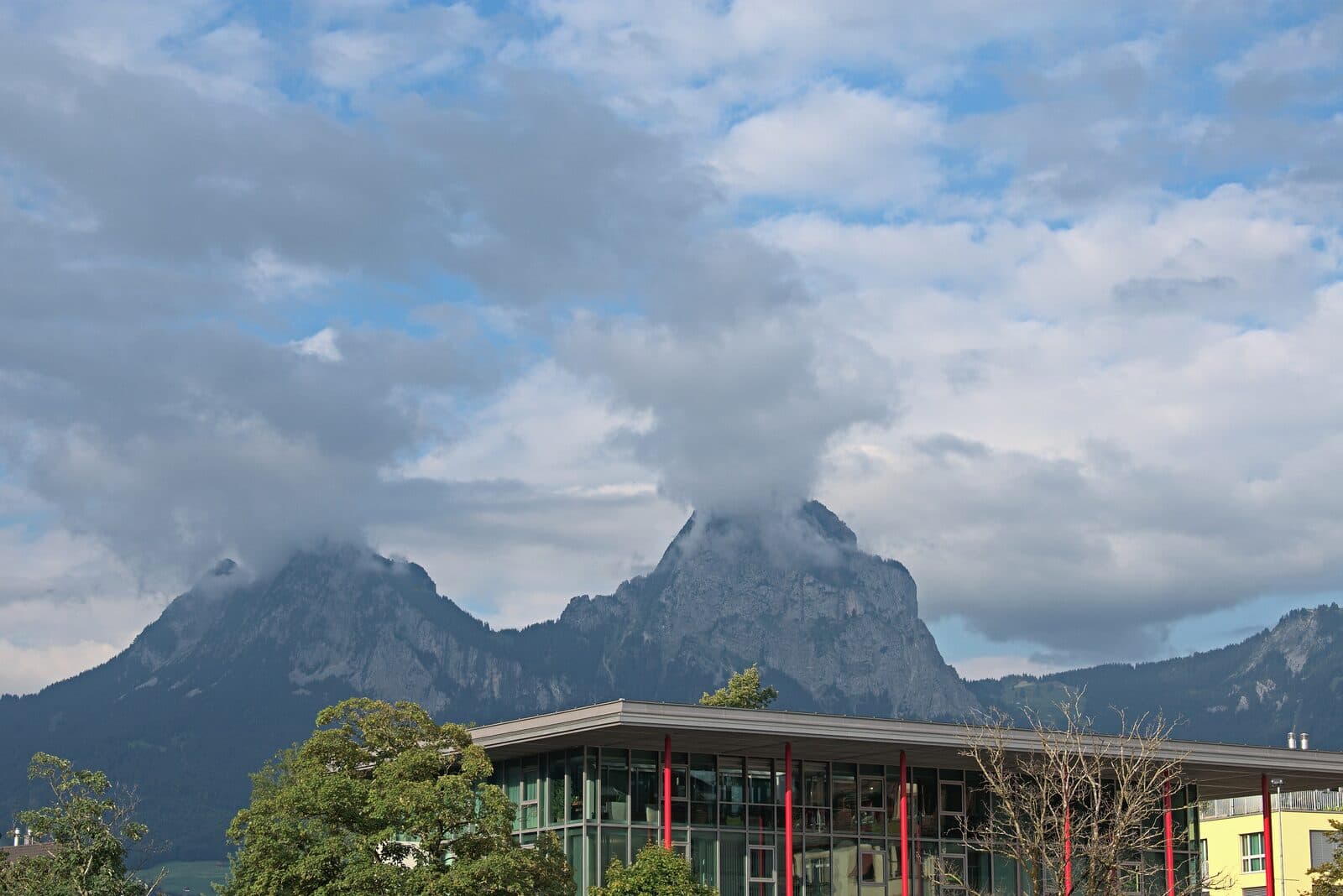
Schwyz (SZ) is a German-speaking canton in Central Switzerland. Its capital, the town of Schwyz, gave the country its name. It has around 170,000 residents, and between roughly a fifth and a quarter of them do not hold Swiss citizenship. For exact figures, check the Federal Statistical Office (FSO) or the cantonal statistics service.
The canton lies close to the Zurich economic area, and its landscape is lakes and mountains. Many residents commute to the Zurich agglomeration.
Which law applies
Schwyz applies federal law first:
- the Federal Act on Foreign Nationals and Integration (FNIA, SR 142.20);
- the Ordinance on Admission, Residence and Employment (OASA, SR 142.201);
- for EU/EFTA nationals, the Agreement on the Free Movement of Persons (AFMP, SR 0.142.112.681) and its implementing ordinance (OFMP, SR 142.203);
- the Asylum Act (AsylA, SR 142.31);
- the Swiss Citizenship Act (SCA, SR 141.0) and the Citizenship Ordinance (SCO, SR 141.01);
- SEM practice and directives.
The canton adds an implementing law for the FNIA and the Asylum Act, a cantonal citizenship act, and an administrative justice act that governs proceedings before the authorities and the administrative court. For exact titles and numbers, check the systematic collection of legislation of the Canton of Schwyz.
The glossaries explain the federal terms: FNIA and OASA, AFMP and OFMP and the Asylum Act.
The migration office
The AFM handles B permits for EU/EFTA and third-country nationals, L and C permits, renewals, changes of status, family reunification (Art. 42 to 47 FNIA) and coordination of naturalisation.
- Website with address, email, phone, online portal and opening hours: https://www.sz.ch/afm
- Federal directory of cantonal migration offices (SEM): https://www.sem.admin.ch/sem/de/home/sem/kontakt/kantonale_behoerden.html
The office's internal organisation and contact details can change; its website always has the current version.
How long it takes
These are rough guides only, not confirmed by the office. The base is around six weeks, and your case can differ a lot depending on how complete your file is, how busy the office is and how complex your situation is. The AFM does not publish an official processing deadline, so ask the office how long your case should take.
| Procedure | Rough guide |
|---|---|
| B renewal | usually shorter than the base (a few weeks) |
| First B permit (work, family reunification) | about the base or longer |
| L permit | about the base |
| Ordinary C permit (after 10 years) | about the base or longer |
| Early C permit (Art. 34 para. 4 FNIA, after 5 years) | about the base or longer |
| Family reunification (third country) | longer than the base |
Where the State Secretariat for Migration (SEM) must approve a cantonal decision (Art. 99 FNIA with Art. 85 and 86 OASA), add several weeks to months. If a decision is seriously delayed, a lawyer can advise you on formal steps.
Language requirements
The language for proof of skills in Schwyz is German. Tests are in standard German, not Swiss German. Levels follow the Common European Framework of Reference for Languages (CEFR).
- Family reunification from a third country: for a B permit, federal law requires German at A1 spoken (Art. 58a para. 1 let. c FNIA with Art. 77d OASA).
- Early C permit (Art. 34 para. 4 FNIA with Art. 62 para. 1bis and Art. 77d OASA): usually B1 spoken and A1 written in German. The canton decides at its discretion, and the language level is only one of several conditions.
Accepted proof includes the fide certificate in German and the diplomas listed in Art. 77d OASA, such as telc, Goethe or ÖSD at the right level. The AFM's practice decides the details and can occasionally differ from the federal standard. See language certificates: A1, A2, B1 and fide.
B, L and C permits
Schwyz follows the federal rules under the FNIA, OASA and SEM directives.
- B permit for work: EU/EFTA nationals have a right to it under the AFMP and OFMP. Third-country nationals must meet the conditions of Art. 18 FNIA: priority for Swiss and EU/EFTA workers, personal requirements, and the usual local and sector salary and working conditions. Permits come out of the federal quotas.
- L short-term permit: for limited purposes under Art. 33 FNIA or under free movement. See the L short-term permit.
- C permit: normally after ten years (Art. 34 para. 2 FNIA). The early C permit after five years for well-integrated people (Art. 34 para. 4 FNIA with Art. 62 para. 1bis OASA) is at the canton's discretion. You need the higher language level, to support yourself without social assistance, sound finances and no relevant criminal offences. You have no legal right to it.
Fees follow the Schwyz fee schedule. Check the official fee schedule or the AFM website for current amounts.
For drafting a specific application, job description or salary structure, ask your employer, an HR service or a specialised lawyer.
See also the B residence permit and the C settlement permit.
Naturalisation
Naturalisation has three levels: the Confederation, the Canton of Schwyz (its cantonal citizenship act) and your municipality. All three must agree.
Federal rules come from two separate texts:
- the Swiss Citizenship Act (SCA, SR 141.0, in force since 1 January 2018): ten years of residence in Switzerland (Art. 9 SCA), suitability (Art. 11 SCA) and successful integration (Art. 12 SCA);
- the Citizenship Ordinance (SCO, SR 141.01): language skills of B1 spoken and A2 written in a national language (Art. 6 SCO), which in Schwyz means German.
If you are a threat to security, you cannot be naturalised. See the 2018 Citizenship Act glossary.
Cantonal and municipal rules: Schwyz also requires several years of residence in the canton and in your municipality. Each municipality sets its own minimum in its regulation, usually a few years. Check your municipality's regulation and the cantonal citizenship act for the binding period. Cantonal and municipal law also decide the interview, any knowledge test and the criminal-record extract.
See paths to Swiss citizenship.
Asylum
Schwyz is part of the national asylum system under the Asylum Act. The accelerated procedure runs in the Federal Asylum Centres (FAC) of the asylum region responsible for the canton; the SEM directory lists the region and sites. If an application moves to the extended procedure, cases go to the cantons under the SEM distribution key (Art. 27 AsylA), and Schwyz takes a share in line with its population.
The legal advice office for asylum seekers (RBS), or the organisation mandated for the canton, is announced by the SEM and the cantonal authorities. It provides the legal representation in the extended procedure foreseen by the Asylum Act (Art. 102f AsylA) and wider advice. See the Asylum Act glossary.
Tax at source and your permit
If you hold a B permit, as a third-country or EU/EFTA national, and no C permit, your employer usually deducts tax from your salary at source. The canton levies and assesses this tax. It is not the same as the federal withholding tax on investment income.
- Above CHF 120,000 gross a year: a subsequent ordinary assessment follows automatically.
- Below that: the tax at source is usually final, but you can ask for an ordinary assessment.
- When it ends: once you get a C permit or marry a Swiss citizen, you are taxed by ordinary assessment.
The cantonal tax administration has the binding rates and rules. For tax questions, ask it or a qualified tax adviser. Registering a home in a canton purely for tax reasons, without really moving your life there, can be treated as abuse under immigration law.
Tax matters for your permit only indirectly. Serious, lasting debt, including unpaid tax, can count in the integration assessment (Art. 58a FNIA) and affect a renewal or a C permit. Tax debts or debt-enforcement proceedings alone do not lead to revocation: the grounds in Art. 62 and 63 FNIA mainly concern security and public order.
Economy and municipalities
The labour market is closely tied to the Zurich area, and many people commute there. Housing in well-connected lakeside municipalities tends to cost more than the Swiss average; for current rents and living costs, check the FSO and regional property indices.
The largest municipalities include Freienbach, Küssnacht (SZ), Einsiedeln and the capital, Schwyz. The official population statistics have the current ranking.
Getting legal help and victim support
This page explains the law and normal cantonal practice. It is not individual legal advice. The canton that handles your case is the one where you live, and moving only to get a better outcome can be treated as abuse. For a hardship case (Art. 30 para. 1 let. b FNIA with Art. 31 OASA), family reunification (Art. 42 to 47 FNIA), separation or divorce (Art. 50 FNIA) or an appeal, contact a lawyer registered with the cantonal bar.
If you are a victim of a crime and need help urgently, the Victim Support Act (VSA, SR 312.5) applies. The cantonal victim-support advice centres of Schwyz can be reached through the cantonal victim-support office or the official website.
Related pages
- German-speaking standard-practice cantons, the cluster Schwyz belongs to
- G cross-border permit, Ci permit for accompanying family
- F permit, N permit, S protection status for people from Ukraine
- Hardship cases under Art. 30 FNIA
- Divorce and your residence permit (Art. 50 FNIA)
- Changing canton and your permit (Art. 37 FNIA)